Easter 1916-2016

O'Connell Street Easter Sunday 2016

O’Connell Street Easter Sunday 2016

Easter Sunday

The streets of Dublin were crowded as thousands of us gathered to watch the Easter 1916 Centenary Commemoration Parade. The day was bright and dry as the massive crowds made their way along the long parade route which led towards O’Connell Street. There were wide screens to display the formal ceremony outside the GPO, as the main street of Dublin city was reserved for family member and relatives of those who fought in 1916.

The parade of the Irish Defence Forces received huge cheers as they passed us, army bands, navy services and all types of military vehicles. President Michael D. Higgins, Taoiseach Enda Kenny, Dublin’s Mayor Criona Ni Dhalaigh and the Minister for Defence, Simon Coveney, all received a warm welcome on this very special day. Everyone watched and was moved by the reading of the Proclamation by Captain Peter Kelleher outside the GPO, the lowering of the Irish tri-colour flag and the army band playing Mise Eire.
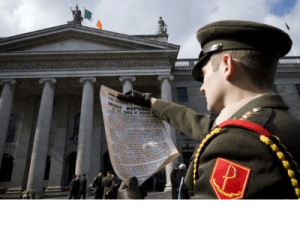
Reading of the Proclamation Easter Sunday 2016

Reading of the Proclamation Easter Sunday 2016

The whole city stood still to remember that day a hundred years ago when a small band of rebels took the GPO and declared an Irish Republic. The Irish Air Corps with their plumes of green white and orange flew over O’Connell Street which brought huge cheers from everyone watching below. This important part of our history was honoured, the brave men and women of 1916 were recalled and their effort to fight for Irish freedom commemorated on this very special Easter Sunday 2016.

Reflecting the Rising

On Easter Monday, the city was transformed for RTE’s large scale event organised for families and all those with an interest in the Rising.
Artist and writer Don Conroy and I were delighted to take part. We gave two 1916 story and drawing workshops in DIT College, Aungier Street, (site of the former Jacob’s biscuit factory and the garrison led by Thomas MacDonagh and Captain John MacBride during the 1916 Rising).

There was fun and hundreds of events and talks on all aspects of the Rising and re-enactments by drama groups with packed events in O’Connell Street, Smithfield and St. Stephen’s Green. Alongside the family activities and entertainment in in St Stephen’s Green, there was the poignant reminder by a children’s drama group of all the children who died during the Rising.

The skies stayed bright and sunny and the marvellous events of the weekend were finished off by RTE’s Centenary concert, broadcast live that night from the Bord Gais Theatre.

It was a weekend to remember and a fitting tribute to Padraig Pearse, Tom Clarke, James Connolly Sean MacDiarmada, Thomas MacDonagh, Eamonn Ceannt and Joseph Plunkett and all those who went out a hundred years ago, on that Easter Monday 1916.

This slideshow requires JavaScript.

Hong Kong and Macau Turn Green

What a great experience to be invited to take part in Macau’s Script Road Writers’ Festival! I met lots of writers not only from China and Portugal but from across the world.

I took part in a lively discussion on ‘The Peculiar Life of Writer’ at The Old Court Building with Sweden’s Bengt Ohlsson and Portugal’s Rui Zink. Also I was kept busy with events across the island, talking in Macau’s University, the International School, the Sir Robert Ho Tung Chinese School, as well as a family event at The Ritz Carlton Hotel.

Great to see Macau’s historic St Paul’s Church turn green, like many iconic buildings around the world, to celebrate St Patrick’s Day. Dublin’s Lord Mayor, Criona ni Dhalaigh, spoke at the Hong Kong and Macau Irish Festival‘s St. Patrick’s Day dinner in the Grand Lapa Hotel. The next day she led off the first St. Patrick’s Day parade to be held on the island.

Watching the local Irish dancing groups, traditional lion dancers and the Chinese dragon, as well as local hip-hop dancers and the police bag-pipers, I felt very proud to be part of such a multi-cultural celebration of Ireland’s heritage.

In Hong Kong, the Mayor of Dublin presented Father Joseph Mallin – aged 102 – with the great honour of the Freedom of Dublin City. Father Joseph, son of Michael Mallin the 1916 Rising leader, is not only the last living child of an executed leader of the Rising but has dedicated his life to working and helping those in need in Hong Kong.

A concert entitled ‘Mise Eire’ was held to celebrate and commemorate the centenary of the 1916 Rising and was attended not only by the Irish community living in Hong Kong, but also by those with an interest in Ireland. I was very honoured to read a chapter from Rebel Sisters to the large audience and to get the chance to meet Father Mallin.

Well done to Ireland’s Consul, General Peter Ryan and all those involved in organising such a special event to mark the centenary of the 1916 Rising!

This slideshow requires JavaScript.

The Royal College of Surgeons in Ireland

Royal College of Surgeons in Ireland

Royal College of Surgeons in Ireland

The Royal College of Surgeons in Ireland, a large medical school to train doctors and surgeons, has stood on St Stephen’s Green, Dublin for over 200 years.

On Tuesday the 25th April 1916, the nationalist rebels were forced to flee under heavy machine gun fire from St Stephen’s Green Park to the nearby large, imposing medical school.

Countess Constance Markievicz had managed to gain access to the college by threatening the college porter with her gun. He and his family were locked up in their quarters as Commandant Michael Mallin’s company took over the building. They put snipers up on the roof and raised the Irish tricolour flag.

The medical college was closed for the Easter holidays so there was very little food or supplies in the building. Commandant Mallin, a former British soldier who had served in India, organised his garrison in an orderly military fashion. The garrison however came under immense fire as the British moved three heavy machine guns and gunners on to nearby roofs to attack them.

Desperately short of food, Nellie Gifford and the other women in the garrison kept up a constant search to find new food supplies, raiding nearby buildings.

Margaret Skinnider was shot during an attempt to disable a nearby British machine gun post and was brought back to the college for medical treatment for her wounds.

As the situation worsened, Chris Caffrey and Nellie Gifford were dispatched to the Jacob’s Biscuits factory to request much needed food and ammunition supplies for their garrison.

A cache of sixty rifles belonging to the college’s Officer Training Corps was found in the college, but the exhausted and hungry men and women in the garrison were under constant heavy attack from the surrounding British forces.

On Sunday morning, 30th April, Nurse Elizabeth O’Farrell – carrying a white flag – came to the college with orders from Britain’s General Lowe and the surrender order signed by Padraig Pearse and James Connolly. She told them that the GPO had fallen and that they must agree to surrender.

With heavy hearts and great reluctance, Michael Mallin and Countess Constance Markievicz agreed to surrender. They took down the Irish flag from the college roof and hid it inside Margaret Skinnider’s coat before she was transported by ambulance to a nearby hospital.
As they left the college building, Major De Courcy Wheeler could not believe such a small group had manged to withstand such heavy attack from his forces.

A hostile crowd jeered and taunted them as they were marched through the streets to Richmond Barracks, led by Michael Mallin.

St. Stephen’s Green

St. Stephen's GreenMany visitors to Dublin’s beautiful city centre park are unaware that it too played a part in the 1916 Rising.
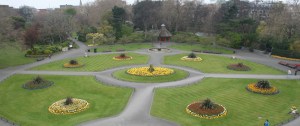
On Easter Monday the 24th of April 1916, Michael Mallin’s company, made up mostly of the men and women of the Irish Citizen Army, marched from Liberty Hall through the city streets to St Stephen’s Green, the large 22 acre public park located in the very heart of Dublin city.

The former resident’s park had reopened to the public in 1888 following the generosity of Arthur Guinness-Lord Ardilaun, who had it re-designed, creating a lake, waterfall and large herbaceous borders.

On that warm sunny Easter bank holiday Monday, the park was filled with families and visitors, who were ordered by the rebels in the name of the Republic, to leave the park immediately. The park superintendent refused to leave as he wanted to take care of the park’s water fowl.

St. Stephen's Green aerial viewCountess Markievicz arrived in her car to inspect the garrison and Commandant Michael Mallin asked her to stay as he needed sharp shooters and she was an excellent shot. She was his second-in-command.

A Red Cross station run by Madeline Ffrench-Mullen was set up in in the bandstand for the wounded and the glass house and pavilions were used for the wounded and as an army kitchen. They dug trenches and set up barricades around the roads outside of the park. There was some firing, but as night fell it began to rain and the garrison tried to find shelter to sleep.

In the early hours of Tuesday morning, they came under heavy attack from British machine gunners located up on the roof of the Shelbourne Hotel, which under cover of darkness had been taken over by the British army who had positioned a heavy machine gun there.

The park provided little cover for the rebels from such an onslaught of firing. A number of men died, some were wounded. Commandant Mallin tried to carry some of his men to safety. Realising that their position was far too open and untenable he gave the order to evacuate St Stephen’s Green.

Countess Markievicz sculptureCountess Markievicz led a party to the nearby Royal College of Surgeons, the large medical school on the west side of the park and they managed to gain entry there. As the whistle sounded, the men and women under his command fled to the safety of the college building. They left their dead in the park and much of their supplies as they escaped under intense enemy machine gun fire.

During the week of the Rising both the British soldiers and the Rebels agreed to a twice daily truce or cease fire to enable the ducks, swans and birds to be fed and to swim and dabble in the water.

In St Stephen’s Green there is a statue of Countess Markievicz. Information panels to mark the Centenary of 1916 Rising were unveiled in March 2016.

Happy St. Patrick’s Day!

Hong Kong Macau Irish Festival logoThis year I am spending St. Patrick’s Day over in Macau and Hong Kong as I am taking part in The Script Road – Macau Literary Festival and also the Hong Kong Macau Irish Festival.

There are lots of writer events along with a St Patrick’s Day parade and a dinner in Macau.

I will also be taking part in Mise Eire – a concert marking the 100th Anniversary of the 1916 Rising – that is being held in Hong Kong.

It’s going to be busy, but I will be back home to Dublin in time for our own very special 1916 Easter Rising Commemorations.