Arbour Hill

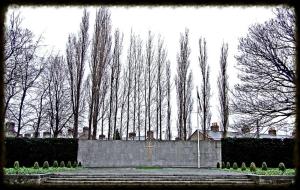
Arbour HillArbour Hill Cemetery was part of the Arbour Hill Military Prison. Following the execution of the fourteen leaders of the 1916 Rising by firing squad over a number of days from the 3rd of May to the 12th of May 2016 in Kilmainham Gaol, their bodies were immediately moved by truck to Arbour Hill for burial.
General Maxwell had ordered the digging of a large pit, a mass grave in Arbour Hill to hold the bodies of all those he intended executing. Although all the families of the executed leaders each requested the remains of their loved ones for burial, General Maxwell refused. He feared that their funerals would attract and arouse sympathy and support and that the rebellion leaders’ graves would become places of pilgrimage. So instead, in the early hours of the morning, with few witnesses, their bodies were buried together in a quicklime pit. A sympathetic sergeant major however put a numbered brick at the head of each of their bodies and kept a list of their names.

Years later, the Irish Republic converted the military cemetery to a place of remembrance for those that had died for Ireland. A low mound surround on a granite terrace forms the official grave of the 1916 leaders, bearing each of their names written in concrete. Behind the graves is a wall with a cross and The Proclamation of The Irish Republic – written in both Irish and English.

Arbour Hill is free to visit and is situated only a short walk away behind The National Museum at Collins Barracks -along the quays. The museum, which is situated in a magnificent large old British Military Barracks, is well worth a visit and has a large selection of 1916 items on display.

Kilmainham Gaol

Following the surrender and the ending of the Easter Rising, many of the rebels were sent to Dublin’s Kilmainham Gaol. Kilmainham Gaol first opened in 1796 and the notorious Dublin prison housed criminals (male, female and even children) in its dank, cold cells and behind its high prison walls.

In the past, murderers and thieves had faced long incarceration and hanging there. Some were just petty thieves, others were convicts awaiting transportation to Australia. Many Irish revolutionaries and nationalists like Robert Emmet, John Dillon, Jeremiah O’Donovan Rossa and Charles Stewart Parnell were also imprisoned there.

Nellie Gifford was among the women from the various rebel garrisons transferred from Richmond Barracks to Kilmainham following the surrender. Countess Constance Markievicz was also imprisoned there.

Following their trial and sentencing by General Maxwell, many of the leaders of the Rising were transferred to Kilmainham to await their execution.

The executions began early in the morning just before dawn on Wednesday 3rd May with Patrick Pearse, Thomas Clarke, Thomas MacDonagh all shot by an army firing squad in the Stonebreakers’ Yard. Their bodies were removed afterwards to be buried in the prison cemetery of Arbour Hill military prison.

On Wednesday evening, a determined Grace Gifford arrived to the prison and was granted permission to marry her fiancé Joseph Plunkett who was due to be executed. They were married around midnight in the candle lit prison chapel but were not let talk to each other and afterwards, Joe – still in chains – was returned immediately to his prison cell. The prison chaplain organised for his bride, Grace, to stay close by and a few hours later a driver from the prison was dispatched to collect Grace to bring her back to the prison. In a crowded cell watched by soldiers she and her husband Joe said their final goodbyes.

Only a short while later on 4th May, Willie Pearse, Edward Daly, Michael O’Hanrahan and Joseph Plunkett were all led out to the Stonebreakers’ Yard where they were shot by firing squad.

Nellie Gifford, hearing of the deaths of her brothers-in-law Thomas MacDonagh and Joe Plunkett, was so overcome with tears and upset that the matron of the prison let Doctor Kathleen Lynn go to her cell to comfort her.

Major John MacBride, Maud Gonne’s former husband, who had volunteered to help command Jacob’s Biscuit Factory was executed on Friday 5th May.

On Monday 8th of May, Michael Mallin, Eamonn Ceannt, Sean Heuston and Con Colbert all bravely faced the prison’s firing squad in the early hours of the morning.

The badly wounded James Connolly was court martialled from his hospital bed in Dublin Castle on the 9th May. His wife Lily and daughter Nora were let visit him at midnight in Dublin Castle on the 11th May. An hour or more later, dressed in his pyjama,s he was transferred on a stretcher by ambulance to Kilmainham Gaol where he was blindfolded and lifted onto a chair in the Stonebreakers’ Yard as he was unable to stand. In the early hours of that May morning, James Connolly faced the same firing squad of twelve soldiers and a sergeant, that had already executed his friend Sean MacDiarmada.

Following their executions, the bodies of each of the dead rebels were transferred immediately in the early hours of the morning for burial to the cemetery in Arbour Hill Military Prison. The British did not want to give the Nationalists and those who supported the Rising the opportunity to organise large funerals for their dead leaders.

Kilmainham Gaol closed in 1924 and fell into disrepair over the following years. Nellie Gifford was among those who campaigned for the restoration of Kilmainham as a historic site of interest.

Kilmainham Gaol was restored over many years and now is open for visitors. It is one of Ireland’s most popular visitor attractions and is well worth a visit. It has a very special atmosphere and is steeped in Irish history. It is advisable to take a guided tour as you get a far better picture of the past and prison life in Kilmainham.

There is also an excellent museum there with a large 1916 display. As Kilmainham gets very busy, I would suggest you book online – if possible – or to try to go there early in the morning.

This slideshow requires JavaScript.

Grace Gifford and Joseph Plunkett’s Wedding

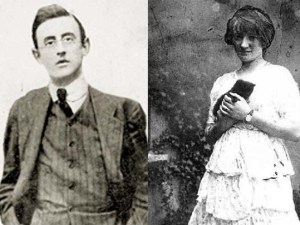
Joseph Plunkett and Grace Gifford

Joseph Plunkett and Grace Gifford

Artist Grace Gifford married writer and 1916 Rising leader Joseph Plunkett at around midnight on Wednesday 3rd of May 1916. The story of their candle-lit marriage in the Chapel of Kilmainham Gaol, a only a few hours before Joe would face a firing squad in the prison’s Stone Breakers’ Yard, not only deeply moved me, but inspired me to write Rebel Sisters and to begin to research 1916 and find out more about this bright, intelligent couple who would pay such a high price for their part in the fight for Irish freedom.

Grace had heard earlier that morning of the execution in Kilmainham Jail of her sister Muriel’s husband, Thomas MacDonagh, alongside Padraig Pearse and Tom Clarke. Determined to go ahead with her own planned marriage to Joe, she went and got the necessary permissions and a wedding ring and went to the prison. She was left waiting there for hours.

The prison governor, Major Lennon, agreed to the marriage and at nearly midnight Grace she was brought to the prison’s chapel. Joe was led in to join her in handcuffs. She was shocked by Joe’s appearance. Father Eugene McCarthy gestured to the soldiers to un-cuff him for the ceremony. They were barely let speak as the priest married them. At the end of the short marriage ceremony, they were given no time together as Joe was re-cuffed and marched back to his prison cell. Grace left Kilmainham and Father McCarthy organised for her to stay with a friend of his who lived close to the prison.

At two am Grace received a message from Major Lennon saying that she was permitted to visit her husband one last time before his execution. He had sent a driver from Kilmainham to collect Grace and drive her back to the prison.

The small cell was crowded with soldiers and their bayonets. Joe was brave and seemed unafraid to die. The new bride and groom, Grace and Joe, were given only ten minutes to talk and say what was in their hearts before saying goodbye to each other.

A short while later Joseph Plunkett was led out to the Stonebreakers’ Yard to be shot. He faced the firing squad and his death bravely, saying that he was happy to die for the glory of God and the honour of Ireland. His body was put in an army ambulance and transported alongside the bodies of Willie Pearse, Ned Daly and Michael O’Hanrahan to Arbour Hill for burial in the lime pit there.

The story of Grace Gifford’s and Joseph Plunkett’s romantic and doomed wedding, in the prison chapel, before he was shot soon spread. The story was taken up by newspapers in Ireland and England and across the world and was one of the elements that helped to change public opinion about the rebellion and the execution by the British of its leaders.

In 1985, Irish musician Jim McCann, a former member of The Dubliners, recorded Grace – a song written by Sean and Frank O’Meara about the wedding of Joseph Plunkett and Grace Gifford in Kilmainham chapel. This much loved ballad, Grace, became a huge hit and is still one of Ireland’s most popular love songs.

https://youtu.be/SMf6IyJI0e4

Signatories – a great 1916 drama

SignatoriesI saw Signatories at the Pavilion Theatre last night and really enjoyed and was moved by this rich, multi layered dramatic reflection on the lives of the seven signatories of the Irish Proclamation and Elizabeth O’Farrell, the young nurse charged with bringing the surrender order from garrison to garrison.

The series of eight ten minute monologues was commissioned by UCD as part of its Decade of Centenaries Programme. Directed by Patrick Mason with writers Frank McGuinness, Emma Donoghue, Thomas Kilroy, Eilis Ni Dhuibhne, Marina Carr, Joseph O’Connor, Rachel Fehily and Hugo Hamilton each writing about one of the signatories.

Emma Donoghue’s piece on an aging Elizabeth O’Farrell – played by Barbara Brennan – recalling the surrender, waving her white flag as she moved from place to place was a strong and most memorable opening to this dramatic and emotive piece of theatre. It was first staged in Kilmainham Jail over three nights and now will be staged in a few more places including the National Concert Hall and the Civic Theatre in Tallaght, a hundred years after the men faced their executions in Kilmainham.

Watching and listening to the last hours and words and thoughts of some of the signatories as they waited in their cells to be executed, certainly brought the humanity and tragedy of the 1916 Rising to life.

The bravery and courage of Padraig Pearse, Thomas MacDonagh, Joseph Plunkett, Tom Clark, Sean MacDiarmada, James Connolly and Eamonn Ceannt, and their belief in a free Ireland certainly deserves to be remembered by some of Ireland’s finest writers.

Book a ticket as soon as you can and hope that Signatories will transfer in time to a theatre near you.

The GPO–Easter Monday 24th April 1916

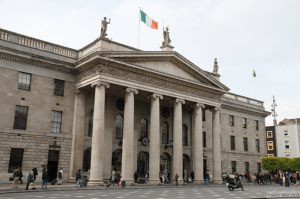
GPO DublinIt is hard to believe but on Monday 24th April 1916 – a hundred years ago – The Rising began!!

On Easter Monday 24th April 1916 Dublin’s, General Post Office was taken over by a large group of Nationalist Rebels led by Padraig Pearse and James Connolly. The members of The Volunteers and The Irish Citizen Army, armed with guns and sundry array of weapons, marched from Liberty Hall towards Sackville Street.

The day was sunny and crowds gathered heading for the races at Fairyhouse, to Phoenix Park or to the seaside. Many of the shops were shut but the GPO remained open to sell stamps, for letter and parcel post and for members of the public to collect government allowances and pensions.

James Connolly, the Union leader and head of the Irish Citizen Army, alongside Padraig Pearse, Joseph Plunkett and William James Brennan Whitmore had led the rebel army toward the large imposing neoclassical landmark building which had been designed by Francis Johnson and built in 1818.

With its large stone portico and six towering granite columns, the GPO was the hub of both postal and telegraph communications in the city. They stopped outside on the street and Connolly gave the order to turn left and charge the GPO.

Customers and staff were all ordered out of the building as the rebels smashed the glass windows and barricaded them. The green, white and orange Irish tricolour flag and the green and gold flag of the Irish Republic were both hoisted and flown up over the building
Padraig Pearse joined by James Connolly and a few others stepped outside where he declared an Irish Republic as he read out the proclamation of The Provisional Government Of The Irish Republic To The People Of Ireland to the crowds of curious onlookers on the street.

Some listened but others chose to walk away. Copies of the printed proclamation were left for the public to read.

The rebels came under attack a short while later by a party of Irish lancers, the mounted cavalry on horseback who came down Sackville Street. Coming under heavy fire from the rebels, the riders and horses were forced to retreat.

On Easter Monday the long cherished dream of a rising against the British had finally happened with a number of key building and locations captured by the force of 1,200 men and women throughout the city.

The GPO garrison, headquarters of the rebellion, was well fortified and they set up barricades. They had a supply of food from the well- stocked kitchens of the nearby hotels and took over the adjacent Metropole Hotel. Commandant Brennan and a group of men were sent to take over the buildings opposite the GPO on Earl Street.

The rebels watched in dismay as around them local people began to loot the nearby shops and businesses immediately, smashing glass windows and doors and stripping the business of their stock.

Taken by surprise, the British Army sent more soldiers to Dublin to quash the rebellion. By Wednesday they had a heavy machine gun and two other guns trained on the GPO which came under steady and constant b ombardment from the British gunners. A British gun ship had sailed up the Liffey and destroyed Liberty Hall.

By Thursday much of Sackville Street on both sides was ablaze. The Imperial Hotel, the Metropole Hotel and the surrounding shops and cafes were on fire as the sky filled with flames and smoke. The street had become a raging inferno. James Connolly was badly wounded, shot in the leg.

The fires raged on and by Friday evening the decision to evacuate the GPO which had already started to burn was made.
The O’Rahiily and a number of the Volunteers tried to make a run for Moore Street but he was fatally injured. The rest of the garrison escaped through Henry Street and Henry Place to Moore Street where they began to boring holes between the houses there trying to get to safety.

The GPO was now totally ablaze, most of the building destroyed. As machine guns raged relentlessly against them and fires raged, and with little food in the city, Padraig Pearse knew they could not continue as innocent civilians were being shot and killed. With heavy hearts the decision was made to surrender – with Pearse and Connolly both signing the surrender order.

On midday Saturday 29th April Nurse Elizabeth O’Farrell stepped out with a white flag. Later she accompanied Padraig Pearse to meet General Lowe to officially surrender. She also helped deliver the surrender orders to all the other rebel garrisons.

On Sunday the remaining rebel garrisons had all reluctantly agreed to surrender too.

The men and women of the rebel garrisons were marched under army escort through the hostile crowds to Richmond Barracks. Some of the women were transferred to Kilmainham Jail.

Under General Maxwell’s orders, many were transported almost immediately to prisons across Britain and Wales. Determined to stamp out any further chance of rebellion, General Maxwell also ordered the trial and execution of the leaders of the rising – many of whom would be sent to Kilmainham Jail to await their fate.