On Stage-Under the Hawthorn Tree

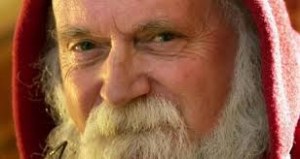
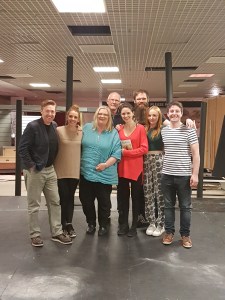
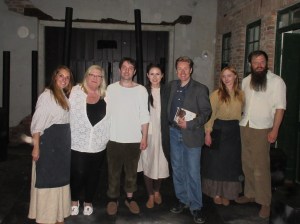
20160617_164026What an emotional experience to see Under the Hawthorn Tree staged by Northern Ireland’s wonderful theatre company, Cahoots, in the Ulster American Folk Park in Omagh.  I was so excited, as I had been very impressed when I attended the rehearsals in Belfast.

An amazing cast brought the story of Eily, Michael and Peggy to life. Music, song and the haunting Uileann pipes all added to the drama of one family’s fight to survive during Ireland’s Great Famine. The play was adapted by Charles Way and directed by Paul Bosco McEneaney.

IMG_0408The Ulster American Folk Park is a great place to stage it, as I as visited it to research my books. The Park now holds Hawthorn Days in the spring.

The play opened on Tuesday 21st June and will run there until 1st July.  There are two shows a day and tickets must be booked with the Ulster American Folk Park.


Book Clubs – Rebel Sisters

Book Club IllustrationIt is great to see Rebel Sisters become such a big Book Club choice. It is a great honour to have so many book clubs all over the country reading and discussing my new novel based on the lives of the Gifford sisters. Rebel Sisters was also a Sean O’ Rourke’s RTE Radio Show Book Club choice.

There is a huge interest in the changing lives of women of the period leading up to 1916 and the complexities of Irish history which would see a family like the Giffords, loyal to the crown and empire, torn apart. As their brothers enlisted to fight in the Great War, Muriel, Grace and Nellie found themselves instead caught up in plans for the Nationalist rebellion.

Writing a book about three young women who were so deeply involved at the very heart of the 1916 Rising was certainly a very big subject to take on but I am so please at the huge interest in the book and the fact that it has encouraged so many readers to delve further into the events of 1916.

I had a lovely time speaking at a big Book Club lunch held in Elm Park Golf Club in Dublin where I had the chance to meet lovely readers from different book clubs, who had lots of questions and insights into the book.

Thank you to all my wonderful Book Club readers!

Books and Bealtaine Festival

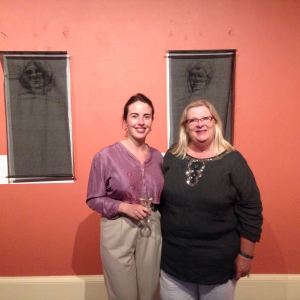
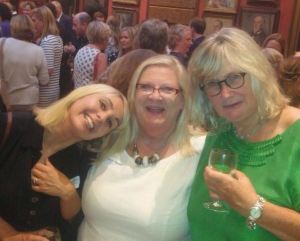
Marita with Sarah Webb and Cormac KinsellaI am having one of these madly busy weeks. Just got back from talking down in Scoil Mhuire in Abbeyside, Waterford and headed to The Ark in Temple Bar to take part in the Bealtaine Festival at an event with Sarah Webb and Cormac Kinsella. Lots of lovely book talk!

On Tuesday night it was off to Hodges Figgis for the launch of Sam Blake aka Vanessa O’Loughlin’s new crime thriller book Little Bones. It is set in Ireland and I’m sure will be a big success. Vanessa has done so much to inspire and help other people get into print, so now it is her turn to write a best seller. Met lots of lovely ladies who just happen to be crime writers too, so be prepared – there will be lots of fictional murders heading your way!!!

Finally I am delighted to hear the very good news that my friend the illustrator PJ Lynch is the new Children’s Laureate 2016.

Arbour Hill

Arbour HillArbour Hill Cemetery was part of the Arbour Hill Military Prison. Following the execution of the fourteen leaders of the 1916 Rising by firing squad over a number of days from the 3rd of May to the 12th of May 2016 in Kilmainham Gaol, their bodies were immediately moved by truck to Arbour Hill for burial.

General Maxwell had ordered the digging of a large pit, a mass grave in Arbour Hill to hold the bodies of all those he intended executing. Although all the families of the executed leaders each requested the remains of their loved ones for burial, General Maxwell refused. He feared that their funerals would attract and arouse sympathy and support and that the rebellion leaders’ graves would become places of pilgrimage. So instead, in the early hours of the morning, with few witnesses, their bodies were buried together in a quicklime pit. A sympathetic sergeant major however put a numbered brick at the head of each of their bodies and kept a list of their names.

Years later, the Irish Republic converted the military cemetery to a place of remembrance for those that had died for Ireland. A low mound surround on a granite terrace forms the official grave of the 1916 leaders, bearing each of their names written in concrete. Behind the graves is a wall with a cross and The Proclamation of The Irish Republic – written in both Irish and English.

Arbour Hill is free to visit and is situated only a short walk away behind The National Museum at Collins Barracks -along the quays. The museum, which is situated in a magnificent large old British Military Barracks, is well worth a visit and has a large selection of 1916 items on display.

Kilmainham Gaol

Following the surrender and the ending of the Easter Rising, many of the rebels were sent to Dublin’s Kilmainham Gaol. Kilmainham Gaol first opened in 1796 and the notorious Dublin prison housed criminals (male, female and even children) in its dank, cold cells and behind its high prison walls.

In the past, murderers and thieves had faced long incarceration and hanging there. Some were just petty thieves, others were convicts awaiting transportation to Australia. Many Irish revolutionaries and nationalists like Robert Emmet, John Dillon, Jeremiah O’Donovan Rossa and Charles Stewart Parnell were also imprisoned there.

Nellie Gifford was among the women from the various rebel garrisons transferred from Richmond Barracks to Kilmainham following the surrender. Countess Constance Markievicz was also imprisoned there.

Following their trial and sentencing by General Maxwell, many of the leaders of the Rising were transferred to Kilmainham to await their execution.

The executions began early in the morning just before dawn on Wednesday 3rd May with Patrick Pearse, Thomas Clarke, Thomas MacDonagh all shot by an army firing squad in the Stonebreakers’ Yard. Their bodies were removed afterwards to be buried in the prison cemetery of Arbour Hill military prison.

On Wednesday evening, a determined Grace Gifford arrived to the prison and was granted permission to marry her fiancé Joseph Plunkett who was due to be executed. They were married around midnight in the candle lit prison chapel but were not let talk to each other and afterwards, Joe – still in chains – was returned immediately to his prison cell. The prison chaplain organised for his bride, Grace, to stay close by and a few hours later a driver from the prison was dispatched to collect Grace to bring her back to the prison. In a crowded cell watched by soldiers she and her husband Joe said their final goodbyes.

Only a short while later on 4th May, Willie Pearse, Edward Daly, Michael O’Hanrahan and Joseph Plunkett were all led out to the Stonebreakers’ Yard where they were shot by firing squad.

Nellie Gifford, hearing of the deaths of her brothers-in-law Thomas MacDonagh and Joe Plunkett, was so overcome with tears and upset that the matron of the prison let Doctor Kathleen Lynn go to her cell to comfort her.

Major John MacBride, Maud Gonne’s former husband, who had volunteered to help command Jacob’s Biscuit Factory was executed on Friday 5th May.

On Monday 8th of May, Michael Mallin, Eamonn Ceannt, Sean Heuston and Con Colbert all bravely faced the prison’s firing squad in the early hours of the morning.

The badly wounded James Connolly was court martialled from his hospital bed in Dublin Castle on the 9th May. His wife Lily and daughter Nora were let visit him at midnight in Dublin Castle on the 11th May. An hour or more later, dressed in his pyjama,s he was transferred on a stretcher by ambulance to Kilmainham Gaol where he was blindfolded and lifted onto a chair in the Stonebreakers’ Yard as he was unable to stand. In the early hours of that May morning, James Connolly faced the same firing squad of twelve soldiers and a sergeant, that had already executed his friend Sean MacDiarmada.

Following their executions, the bodies of each of the dead rebels were transferred immediately in the early hours of the morning for burial to the cemetery in Arbour Hill Military Prison. The British did not want to give the Nationalists and those who supported the Rising the opportunity to organise large funerals for their dead leaders.

Kilmainham Gaol closed in 1924 and fell into disrepair over the following years. Nellie Gifford was among those who campaigned for the restoration of Kilmainham as a historic site of interest.

Kilmainham Gaol was restored over many years and now is open for visitors. It is one of Ireland’s most popular visitor attractions and is well worth a visit. It has a very special atmosphere and is steeped in Irish history. It is advisable to take a guided tour as you get a far better picture of the past and prison life in Kilmainham.

There is also an excellent museum there with a large 1916 display. As Kilmainham gets very busy, I would suggest you book online – if possible – or to try to go there early in the morning.

This slideshow requires JavaScript.