This year’s Famine Summer School which was due to be held in the Ireland’s National Famine Museum in Strokestown will be held instead online on Saturday 29th May.
However for anyone with an interest in in Ireland’s Great Famine this is a great opportunity to listen and to take part in a day filled with exciting new contributions from both international and Irish famine experts and researchers on many aspects of Ireland’s Great Hunger.
I am looking forwardto talking with Caroilin Callery of the National Famine Museum Strokestown Park House about the importance of Education and Outreach in terms of learning about the famine and the National Famine Way.
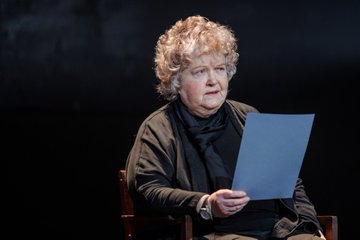
I have just watched ‘Home – Part 1’ the Abbey Theatre’s incredible dramatization of some of the testimonies of women survivors of Mother and Baby institutions.
The Commission of Investigation into Mother and Baby homes published its report in January 2021 with some controversy as many women felt their experiences had not been properly included or covered in the report.
This haunting piece of online theatre performed on the Abbey stage by some of Irelands foremost actresses gave voice to women and girls of all ages that have been ignored for decades. ‘Home’ is still available online from the Abbey.
The Abbey Theatre over the past year has proved itself to be versatile, responsive and innovative in finding a way to bring new theatre to audiences.
On March 11th 2020 The Abbey Theatre had to close its doors due to Covid 19 restrictions as Ireland went into lockdown. However by April 28th the Abbey had gathered itself to produce an incredible new type of theatre available to audiences online to reflect Ireland’s situation with 50 playwrights and 50 actors tasked with reflecting how Ireland was dealing with life during a pandemic.
In ‘Dear Ireland’ over three nights a series of dramatic and extraordinary monologues reflected the difficult new and bewildering situation faced by so many. Isolated from friends, family and routine or working all hours on the frontline. Everyone in that audience aware of the giant step that was being taken by our National Theatre for The Abbey had flung open its doors and reached a massive new audience both at home and overseas.
Such was its success that ‘Dear Ireland’ has continued with further additions to include a wider view of those affected.
Other highlights includes Lisa Tierney Keogh’s ‘This Beautiful Virtual Village’ and a live performance of ‘The Great Hunger’ held outdoors in the grounds of the I.M.MA in Kilmainham which brought Patrick Kavanagh’s epic poem to life.
Michael Foley’s ‘Fourteen Voices from the Bloodied Field’ produced with the GAA gave voice to those who died tragically in an attack, in Croke Park on Bloody Sunday on 21st November 1920. The Abbey even brought award winning writer Edna O’Brien’s T.S Eliot Lecture to its audience.
The Abbey Theatre despite Covid has in that time employed 600 freelance theatre makers, and believe it or not attracted an audience of 324, 490 online. An incredible 46% of that audience were from overseas.
The Abbey Theatre normally would average an audience of 122, 820 attending the theatre annually but this new direction has uncovered a much larger audience for our National Theatre.
While we all look forward to a return to proper theatre. I do hope that the Abbey Theatre will continue to use this exciting new platform to showcase its work and reach a much wider audience including those that often cannot easily manage to get to the theatre, or live in far flung Kerry, Berlin or New York etc.
“Compelling … An accessible and essential book, which does great service to Irish history and charts the courage and steadfastness of the human spirit..” Sunday Times
Marita Conlon-McKenna’s most recent novel, The Hungry Road, published at the beginning of this year, and as such Red Line is eager to highlight a wonderful novel that you might have missed.
Inspired by true Irish heroes, The Hungry Road is the heartbreaking story of the Great Irish Famine told by one of Ireland’s best loved writers.
Join Marita as she discusses the novel, her career and more with fellow novelist, Tanya Farrelly.
Tanya Farrelly is the author of two novels and the prize-winning short story collection When Black Dogs Sing.
It is great to see another important Famine story being told as The National Famine Way and Strokestown Park House launch the video for Daniel’s story.
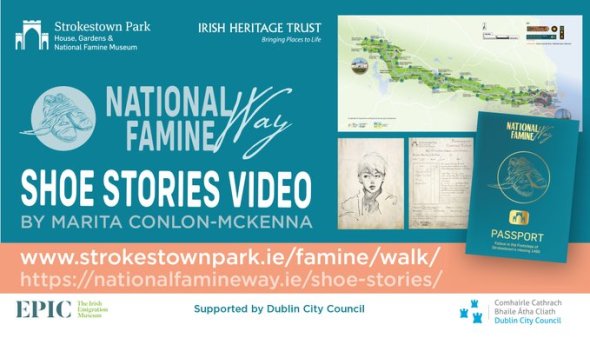
At the height of the Great Irish Famine in May of 1847, twelve year old Daniel Tighe was forced to walk 165km with 1,490 assisted emigrants from the Strokestown Park Estate in County Roscommon along the Royal Canal to Custom House Quay in Dublin. Their sorrowful journey is marked by over thirty pairs of bronze shoe sculptures on the National Famine Way walking trail. I was very honoured to be asked to write Daniel’s story and delighted that now along with the app there is now the National Famine Way Shoe Stories film about Daniel and his family, as they say goodbye to their home place and begin the long arduous walk to Dublin to board ships that will bring them to Liverpool and Canada.
NATIONAL FAMINE WAY SHOE STORIES FILM: Please join us for a live online event in conversation about Daniel‘s great journey and the making of the video on Wednesday, December 2nd at 7pm Irish time, 2pm Eastern Standard Time in North America: Watch the film and register here: http://strokestownpark.ie/famine/walk/ This film and online event are hosted by the National Famine Museum, Strokestown Park and Irish Heritage Trust with funding by Dublin City Council.
On Thursday 3rd December I am really looking forward to another online event joining West Cork readers who are reading The Hungry Road for a lively discussion about the book.
It is great to see the continuing growing interest in finding out more about The Great Hunger and I was very impressed by RTE’s new documentary ‘The Hunger’.
This two part series produced by Tyrone Production is narrated by Liam Neeson and is based on the enormous ‘Atlas of the Great Irish Famine’ which was published by Cork University press in association UCC. The series brings all the research, history and discoveries about the Great Irish Famine to a huge global audience enabling all of us to gain a better understanding of the cataclysmic event that has shaped Irish people and our nation.
Well done to everyone at The Dublin Book Festival and The National Library for going ahead despite Covid with this year’s festival.
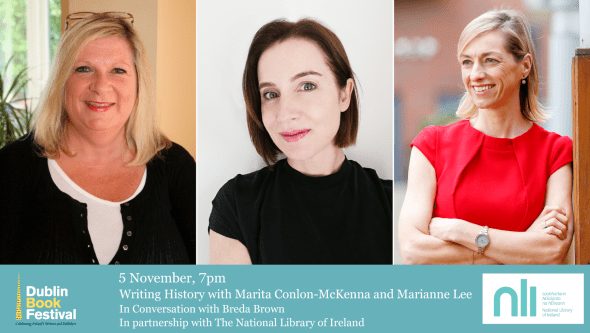
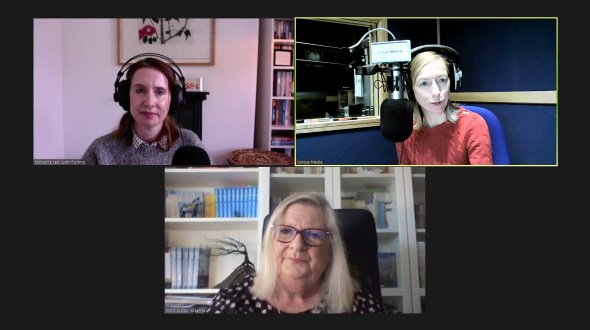
It is a great honour to take part in ‘Writing History’ a podcast with Breda Brown interviewing new writer of A Quiet Tide Marianne Lee and myself about all the intricacies and joys of writing history, something we both love. The podcast will go out on Thursday 5th November at 7pm.
Marianne and I could have talked for hours about our favourite subject and how we each approach writing; researching and building our stories while staying true to those we are writing about
It is unfortunate that here in Ireland we are back in a lockdown phase again to try and curtail the spread of Covid 19 numbers. Like many other sectors The Arts have been badly hit with theatres, concert venues and galleries shut, and many book and literature and music festivals cancelled or curtailed. It has been a huge learning curve for most of us writers who enjoy taking part in festivals and meeting our readers.
Along with working on a new book I have spent this time learning how to make videos, do Zoom events and podcasts interviews and in the past few months have amongst other things taken part in The John Hewitt Summer School,The Dublin History Festival, and The Kildare Readers Festival, with a lovely event planned next month with West Cork Book Groups who are all reading ‘The Hungry Road’.
Recording the Podcast
I have a huge regard for all the wonderful organizers and volunteers who have pressed ahead with these alternate form of events which are proving so popular and finding a new even wider audience reach.